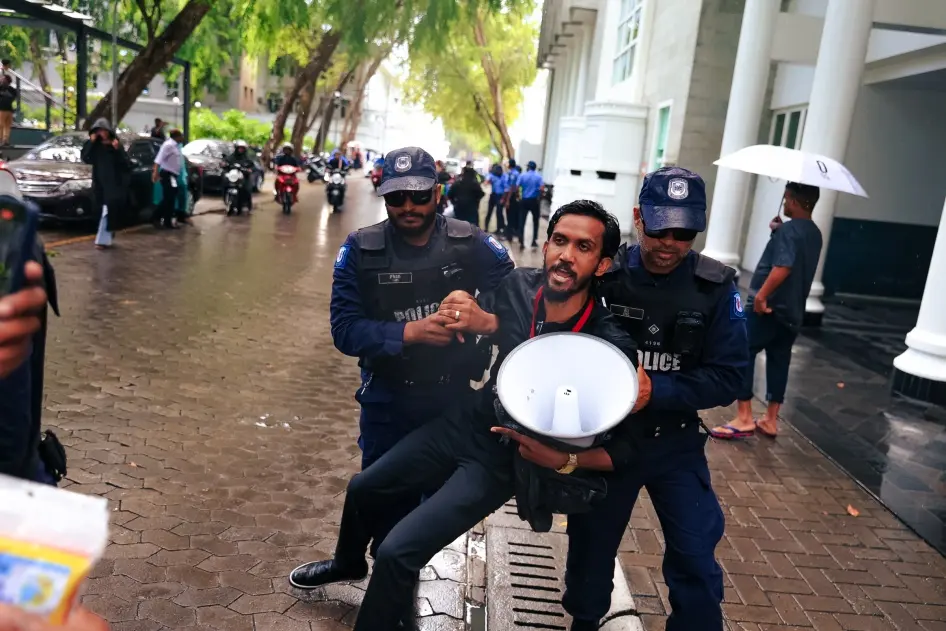
By the end of 2025, the Maldives had entered one of the darkest chapters in its media history. What unfolded over the year was not a single policy misstep, but a coordinated and sustained attack on press freedom, free expression, and independent journalism.
The most defining moment came with the passage of the Maldives Media and Broadcasting Regulation Bill, a controversial law that triggered national and international outrage, drawing sharp criticism from journalists, opposition parties, and global press freedom advocates.
A Bill Passed Under a Supermajority Shadow
In a move that alarmed civil society, President Mohamed Muizzu’s government pushed the bill through parliament, where it holds a commanding supermajority. Critics argue that this political dominance eliminated meaningful debate and scrutiny, allowing legislation with far-reaching consequences for free speech to be rushed into law.
The bill, according to journalists and rights groups, grants sweeping regulatory powers over traditional media, online platforms, and digital journalism, effectively placing the media ecosystem under executive influence.
Journalists Push Back: “A Draconian Law”
The Maldives Journalists Association (MJA), the country’s largest media workers’ union, described the legislation as a direct threat to democracy.
“The Maldivian parliament has passed a draconian bill that seeks to muzzle dissent online and offline, both on traditional media and social media,”
— Ahmed Naaif, Secretary-General, Maldives Journalists Association
In an unprecedented stance, the MJA publicly pledged to defy the bill, signaling a rare and unified resistance from journalists across the country.
“We journalists will stand together in defiance against this takeover of the media by the executive branch,” Naaif told Al Jazeera.
Opposition and Global Alarm
The main opposition party called for nationwide protests, warning that the legislation could reverse years of progress made since the Maldives’ democratic reforms. International press freedom organizations echoed these concerns, urging President Muizzu to veto the bill and respect constitutional guarantees of free expression.
The global response underscored a growing fear: that the Maldives, once seen as a democratic success story in South Asia, is sliding toward authoritarian-style media control.
Government’s Defense: Regulation or Repression?
The government has strongly denied allegations that the bill suppresses free speech. Officials insist it is designed to streamline regulation and combat misinformation.
Foreign Minister Abdulla Khaleel stated that the law would establish:
- “Clear standards and a code of conduct”
- Measures to address “misinformation, disinformation, and coordinated manipulation of content”
He further claimed that personal social media accounts used in a private capacity would not be regulated under the law.
However, journalists and digital rights experts remain unconvinced, warning that vague definitions and broad enforcement powers could easily be weaponized against critics, independent reporters, and dissenting voices.
A Chilling Effect Already Felt
Even before full implementation, media professionals report a growing culture of fear and self-censorship. Newsrooms are reassessing coverage, freelancers are hesitating to publish critical stories, and online commentators are increasingly cautious.
For a nation whose constitution explicitly guarantees freedom of expression, the events of 2025 raise a troubling question: Can independent journalism survive under expanding state control?
Conclusion: Democracy Under Strain
The passage of the Maldives Media and Broadcasting Regulation Bill stands as a defining symbol of 2025—a year in which media freedom came under total attack.
As journalists brace for tighter controls and citizens face shrinking civic space, the future of free speech in the Maldives hangs in the balance. What happens next will determine whether the country upholds its democratic ideals—or becomes another cautionary tale of press freedom lost.